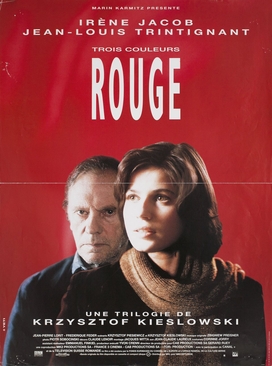
Official promotional poster. Rights belong to the respective rights holders.
Read the film reference Availability and pricing vary by region.Three Colors: RedA movie brief.
1994 / romantic psychological drama mystery art film / Directed by Krzysztof Kieślowski
Lives become intertwined by fate and chance.
What is Three Colors: Red about?
Valentine, a Geneva student and model, and Joseph, a retired judge, form an unlikely bond. Their lives intersect with others, revealing themes of destiny, solitude, and communication.
Five things to know.
Setup
The film centers around Valentine Dussaut, a University of Geneva student who works part-time as a model, and Joseph Kern, a reclusive retired judge.
World
The story is set in Geneva, Switzerland, and explores the interconnected lives of its characters.
Pressure
Valentine and Joseph navigate their complex relationships and personal struggles, including Valentine's possessive boyfriend and Joseph's voyeuristic tendencies.
Craft
The film features stunning cinematography, a powerful score by Zbigniew Preisner, and strong performances from Irène Jacob and Jean-Louis Trintignant.
Viewing Note
The film is a thoughtful, beautifully realized portrait of interconnected lives, exploring themes of destiny, chance, solitude, and communication.
A thought to take with you.
A masterful exploration of human connections and the complexities of life.
Is it your kind of movie?
Fans of character-driven dramas and philosophical themes may appreciate the film's introspective nature. Viewers should expect a slow-burning, contemplative narrative that rewards patience and attention.
Sources & scope
This AI-assisted brief is based on the linked secondary reference. Facts and interpretation are separated; it does not claim personal viewing or independent expert review.
Source details checked October 3, 2026. Suggest a correction · Our editorial approach