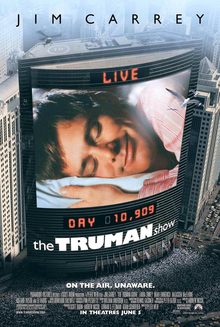
Official promotional poster. Rights belong to the respective rights holders.
Read the film reference Availability and pricing vary by region.The Truman ShowA movie brief.
1998 / Comedy-Drama / Directed by Peter Weir
What if your entire world was a meticulously crafted television show?
What is The Truman Show about?
Truman Burbank lives an idyllic, ordinary life in a picturesque town, seemingly unaware that his every moment is being broadcast to the world. His entire reality is a colossal soundstage, populated by actors and controlled by a visionary creator.
Five things to know.
Unwitting Star
Truman Burbank is the unwitting star of a reality television program, filmed 24/7 through hidden cameras since his birth.
Artificial World
His hometown, Seahaven Island, exists entirely within an enormous soundstage, meticulously designed to control every aspect of his existence.
Controlled Environment
The show's creator orchestrates scenarios, like instilling a fear of water, to prevent Truman from ever discovering the truth about his life.
Visual Inspiration
The film's visual design draws inspiration from 1960s postcards and Norman Rockwell paintings, creating an artificial, idealized suburban aesthetic.
Reflective Viewing
Audiences are invited to consider themes of simulated reality, privacy, and the pervasive influence of media on individual lives and society.
A thought to take with you.
Truman's life looks ordinary because the people around him maintain the same performance every day. As inconsistencies accumulate, he must decide whether familiar comfort is worth more than the chance to test what exists beyond the set.
Is it your kind of movie?
Choose it for a satirical drama about surveillance, entertainment, and personal freedom. The premise is easy to follow and the tone balances comedy with unease.
Sources & scope
This AI-assisted brief is based on the linked secondary reference. Facts and interpretation are separated; it does not claim personal viewing or independent expert review.
Source details checked September 30, 2026. Suggest a correction · Our editorial approach