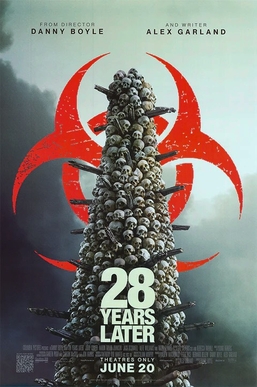
Official promotional poster. Rights belong to the respective rights holders.
Read the film reference Availability and pricing vary by region.28 Years LaterA movie brief.
2025 / horror / Directed by Danny Boyle
Infection knows no borders, but hope can be found.
What is 28 Years Later about?
Twenty-eight years after the Rage Virus outbreak, a young boy named Spike embarks on a hazardous journey with his ill mother to obtain medical treatment. They navigate a post-apocalyptic Britain under quarantine.
Five things to know.
Setting
The film is set in a post-apocalyptic Britain, 28 years after the Rage Virus outbreak, with the British Isles under indefinite quarantine.
World
The story takes place in a quarantined Britain, where a civilized community has been subsisting on Lindisfarne, an island defended naturally by a causeway that floods with the tide.
Pressure
Spike and his mother face immense pressure as they navigate the dangers of the post-apocalyptic world, including Infected humans and scarce resources.
Craft
The film features innovative cinematography, using iPhone 15 Pro Max cameras to capture the action, and a dynamic soundtrack composed by Young Fathers.
Viewing Note
The film is a coming-of-age story that defies traditional horror expectations, blending themes of loss, survival, and self-discovery.
A thought to take with you.
Spike's journey has a practical purpose: obtaining help for his mother. The quarantined setting makes care depend on crossing danger rather than staying sheltered from it. Watch how an obligation to a particular person changes the decisions that survival alone might suggest.
Is it your kind of movie?
Choose it for an infection-world journey centered on a child and his mother; the premise combines a care-seeking mission with exposure to danger.
Sources & scope
This AI-assisted brief is based on the linked secondary reference. Facts and interpretation are separated; it does not claim personal viewing or independent expert review.
Source details checked September 7, 2026. Suggest a correction · Our editorial approach