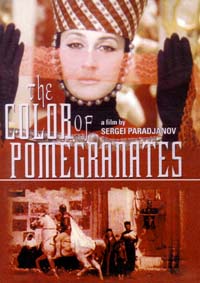
Official promotional poster. Rights belong to the respective rights holders.
View the film source Availability and pricing vary by region.The Color of PomegranatesA movie brief.
1969 / Avant-garde film / Directed by Sergei Parajanov
A poetic biography of an 18th-century Armenian poet's life.
What is The Color of Pomegranates about?
The film visually and poetically explores the life of Sayat-Nova, an Armenian ashug. It presents his life in chapters, using tableaux and minimal dialogue.
Five things to know.
Setup
The film is a poetic treatment of the life of 18th-century Armenian poet and troubadour Sayat-Nova, presented in chapters.
World
The film was shot at numerous historic sites in Armenia, Georgia, and Azerbaijan, showcasing medieval churches and landscapes.
Pressure
Soviet censors objected to Parajanov's stylized treatment of Sayat-Nova's life, leading to changes in the film's title and chapter titles.
Craft
The film features active tableaux, music, and occasional singing, with actress Sofiko Chiaureli playing six roles.
Viewing Note
The film's poetic nature requires patience and attention, as it tells its story through visual and musical elements rather than traditional narrative.
A thought to take with you.
The film presents the poet's life through composed images rather than a conventional sequence of scenes. Objects, fabrics, and gestures function like visual lines of poetry, so the viewer assembles meaning from recurring symbols instead of explanatory dialogue.
Is it your kind of movie?
Choose it for an experimental Armenian-language visual poem about Sayat-Nova. It is highly symbolic and has almost no conventional plot.
Sources & scope
This AI-assisted brief is based on the linked secondary reference. Facts and interpretation are separated; it does not claim personal viewing or independent expert review.
Source details checked October 10, 2026. Suggest a correction · Our editorial approach