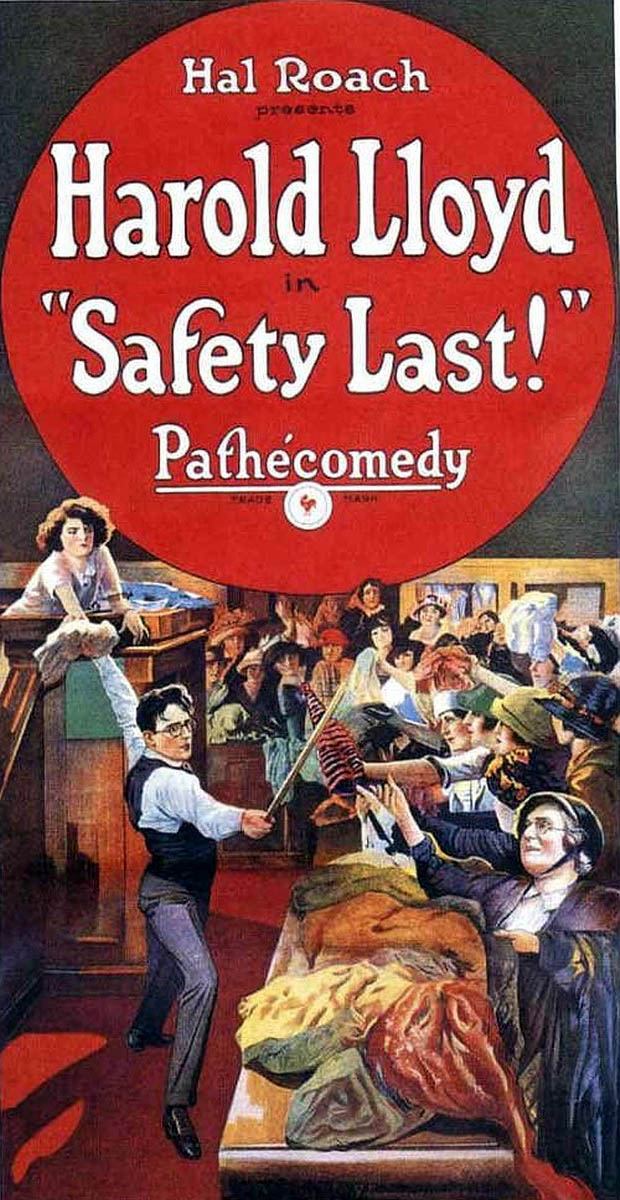
Official promotional poster. Rights belong to the respective rights holders.
Read the film reference Availability and pricing vary by region.Safety Last!A movie brief.
1923 / Silent romantic comedy / Directed by Fred C. Newmeyer, Sam Taylor
Harold Lloyd's thrilling stunts will leave you on the edge of your seat.
What is Safety Last! about?
Harold Lloyd plays a young man who promises to send for his girlfriend so they can get married once he has made a success of himself in the big city. He gets a job as a salesclerk and performs various stunts to impress his boss.
Five things to know.
Setup
The film opens with Harold Lloyd behind bars at a train station, where he promises to send for his girlfriend so they can get married once he has made a success of himself in the big city.
World
The film is set in a bustling city, with Harold Lloyd navigating various locations including a department store, a construction site, and a skyscraper.
Pressure
Harold Lloyd's character is under pressure to impress his boss and support his girlfriend, leading him to perform increasingly daring stunts.
Craft
Harold Lloyd performed many of his own stunts, including climbing the exterior of a building and hanging from a clock, showcasing his impressive physical comedy skills.
Viewing note
The film's stunts and physical comedy hold up surprisingly well even today, making it a must-see for fans of silent cinema.
A thought to take with you.
Harold's promise to his girlfriend gives his work in the city a deadline, while his attempt to appear successful keeps pulling him into schemes beyond his control. The climb turns his social ambition into a physical problem staged high above the street.
Is it your kind of movie?
Choose it for a silent comedy built around Harold Lloyd's skyscraper-climbing sequence. Its suspense comes from carefully staged physical gags.
Sources & scope
This AI-assisted brief is based on the linked secondary reference. Facts and interpretation are separated; it does not claim personal viewing or independent expert review.
Source details checked October 5, 2026. Suggest a correction · Our editorial approach