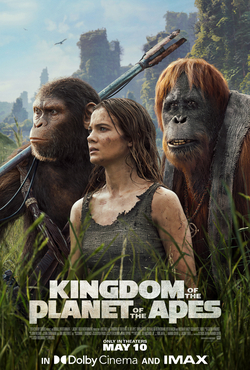
Official promotional poster. Rights belong to the respective rights holders.
Read the film reference Availability and pricing vary by region.Kingdom of the Planet of the ApesA movie brief.
2024 / Science Fiction Action / Directed by Wes Ball
The future of apes and humans hangs in the balance.
What is Kingdom of the Planet of the Apes about?
Many generations after Caesar's death, apes have become the dominant species on Earth, while surviving humans have become feral. A young chimpanzee hunter named Noa embarks on a journey alongside a human woman, Mae, to determine the future for apes and humans alike.
Five things to know.
Setup
The film takes place many generations after the events of War for the Planet of the Apes and follows Noa, a young chimpanzee from a falconry-practicing clan.
World
Apes have become the dominant species on Earth, while surviving humans have become feral and are treated as second-class citizens or used for labor.
Pressure
The apes are threatened by a ruthless leader named Proximus Caesar, who seeks to access human technology to ensure the continued prosperity of apes.
Craft
The film features impressive visual effects, with the computer-generated primates described as breathtakingly hyper-real.
Viewing Note
The film's ending has been described as thought-provoking and insightful, leaving room for a potential sequel.
A thought to take with you.
Noa's journey is shaped by a conflict over how the past should guide a society that has changed since Caesar. The encounter with Mae complicates a simple divide between species: each character carries knowledge and aims the other cannot immediately see.
Is it your kind of movie?
Choose it for a science-fiction adventure focused on inherited history, competing communities, and the meaning of leadership. Prior films add context but the central journey is Noa's.
Sources & scope
This AI-assisted brief is based on the linked secondary reference. Facts and interpretation are separated; it does not claim personal viewing or independent expert review.
Source details checked September 7, 2026. Suggest a correction · Our editorial approach