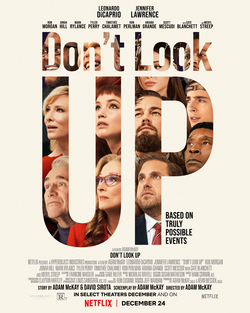
Official promotional poster. Rights belong to the respective rights holders.
Read the film reference Availability and pricing vary by region.Don't Look UpA movie brief.
2021 / Political satire / Directed by Adam McKay
A disaster movie with a message that's hard to ignore.
What is Don't Look Up about?
Two astronomers try to warn humanity about a comet that's on a collision course with Earth. Their warnings are met with apathy and disinterest from politicians and the media.
Five things to know.
Setup
The film is set in a world where a comet is about to collide with Earth, causing widespread destruction and chaos.
World
The movie's central comet impact event serves as an allegory for threats arising from climate change and societal indifference.
Pressure
The astronomers face pressure from politicians and the media to downplay the threat of the comet and avoid panic.
Craft
The film features an ensemble cast, including Leonardo DiCaprio, Jennifer Lawrence, and Meryl Streep, and was written and directed by Adam McKay.
Viewing note
The film's satire can be heavy-handed at times, but it raises important questions about our society's response to science and crisis.
A thought to take with you.
Kate and Randall can calculate the danger, but they cannot make institutions treat the warning as urgent. The comedy comes from the widening gap between the certainty of the evidence and the incentives of people who control public attention.
Is it your kind of movie?
Choose it for an ensemble satire about scientific communication, media incentives, and political delay. It uses a comet as fiction to examine crisis response.
Sources & scope
This AI-assisted brief is based on the linked secondary reference. Facts and interpretation are separated; it does not claim personal viewing or independent expert review.
Source details checked September 8, 2026. Suggest a correction · Our editorial approach