Thinking in Bets: Summary in 5 Key Points
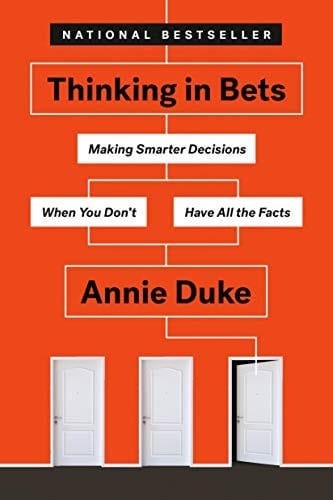
AI-assisted book brief. Verify important claims against the original book; this page does not claim personal reading or independent expert review.
Questions to take into the book
- What could the decision-maker know before the outcome was visible?
- Which part of the result reflects the decision process, and which might reflect luck?
- What evidence would justify changing a confidence estimate rather than merely defending it?
Who should read the full book
This book is ideal for individuals looking to improve their decision-making skills, particularly those in high-stakes professions or facing significant life choices. Readers who are already familiar with decision theory and poker strategy may find some concepts repetitive. Anyone seeking a straightforward self-help book may find the content too complex.
📚 Get the full book on Amazon →How to use this idea
Duke's distinction between a decision and its eventual outcome gives a reader a way to examine judgment without pretending to eliminate luck. A good result can conceal a weak process, and a bad result can follow a reasonable one. The demanding part is preserving what was knowable before the result, so that hindsight does not silently rewrite the explanation of the choice.
Where it has limits
Thinking in probabilities does not make uncertain choices safe or turn limited information into a reliable forecast. This is a framework for evaluating reasoning, not a recommendation to gamble or invest.
A small test to try
Choose a decision described in the book. List the information available when it was made, then assess the reasoning before considering the outcome. Explain what additional evidence could have changed the decision.
AI-assisted editorial interpretation, not a claim of personal reading or independent expert review. Source checked 2026-10-11: Annie Duke: Thinking in Bets and decisions under uncertainty.
Brief your own reading in 10 seconds
Paste any article, essay or notes and get the 5 points that matter. Free, no signup.
Ask anything about this book
Ask for an AI-assisted explanation. Useful questions may be considered for editorial review; repeated requests do not publish an answer.